




You are here

From petroleum engineer to Master of Energy Change scholar
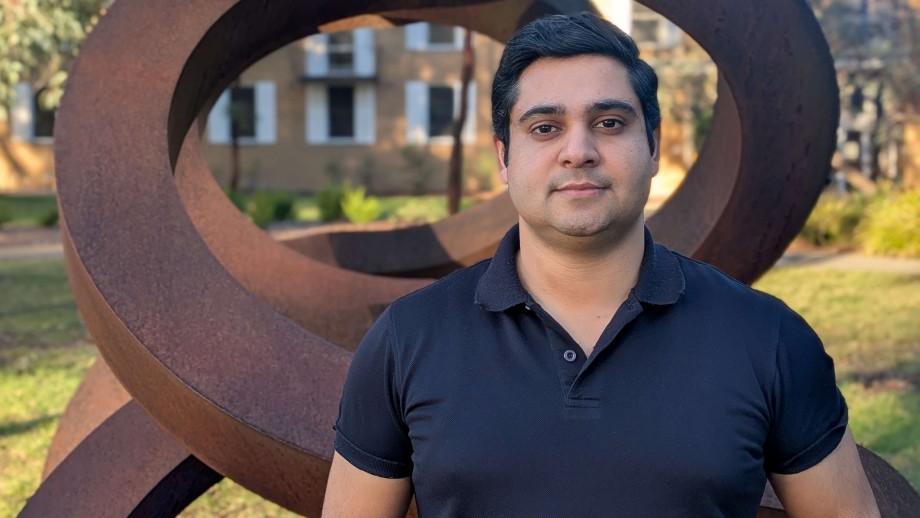
Nadir Ahmad Ameen worked as a reservoir engineer, developing oil and gas fields and estimating fuel reserves in Islamabad before embarking on a very different pathway.
Today Nadir is a ANU Master of Energy Change student and recipient of the Global Power Generation Australia Scholarship in The Hydrogen Economy. He is applying his considerable talent researching one of the gnarlier energy change challenges - fugitive hydrogen emissions and how they interplay with our soil and atmosphere in a future hydrogen economy.
After completing his undergraduate degree in petroleum engineering in 2017 from Curtin University’s Sarawak campus in Malaysia, Nadir returned to his home country, Pakistan. Nadir worked as a petroleum engineer for seven years before reconsidering not only his own future, but the future of his country.
Pakistan is highly vulnerable when it comes to climate change. In 2022 the Climate Risk Index, a long-running annual climate impact report, ranked the country as the most affected by extreme weather events primarily due to devastating floods caused by record-breaking monsoon rainfall. The floods affected over 33 million people, resulting in more than 1,700 fatalities and causing nearly $15 billion USD in damage. In the same year the World Bank estimated that reconstruction efforts would be in the range of 16 billion USD, making it one of the costliest disasters in world history.
“I started to look at alternative career paths as I was unsure of the future of petroleum,” said Nadir. “I was looking to transition to clean energy – to a more predictable industry and to assist my country in the energy transition.”
“I started my search for energy transition degrees worldwide, in particular I was looking at opportunities in the United States, the United Kingdon, Canada and Australia. I declined an offer from a university in the US as I had concerns about what was happening in the US’s political sphere.
Nadir accepted an offer to study the Master of Energy Change (MENCH) at ANU and made the big move to Australia with his wife and daughter in February 2025 to embark on the two year degree. “I was impressed by the wide suite of courses MENCH offered. Flexibility was the key for me and there was a lot of variety on offer through the program”.
Now in his second and final year, Nadir is taking a deep dive into the effects of hydrogen on our environment. “My research is looking at the problem of hydrogen leakage, or fugitive emissions," said Nadir. Hydrogen molecules are smaller than methane molecules potentially making hydrogen leakage more of a problem. Hydrogen is also an indirect greenhouse gas, which means its release into the atmosphere can result in an increase of concentrations of direct greenhouse gases like methane.
“The atmosphere and soil are natural sinks for hydrogen but there is a lot of uncertainty especially with soil – we don’t know a lot about what factors influence the hydrogen uptake by soils the most – and yet estimates suggests it absorbs up to 80 per cent of hydrogen. Soil chemistry may be very variable across geographies. What will happen to hydrogen uptake with an altered soil chemistry in future? We are trying to predict this and come up with policies and recommendations which may help us retain the benefits of decarbonisation once we incorporate more hydrogen in our economies,” said Nadir.
Hydrogen is touted to play a role in the harder to abate sectors, such as the steel industry and long-haul transportation. “There is opportunity for Australia to lead the world in hydrogen production,” explains Nadir. "Projected pathways indicate we could be looking at anywhere from 150 mega tonnes to more than 500 mega tonnes per year of hydrogen use in the world."
On his research journey, Nadir is being guided by some of the University’s finest thinkers. “MENCH offers you opportunities to study across many of the ANU Colleges. I particularly enjoyed the course Principles of Energy Generation and Transformation, offered by the Research School of Physics, and Environmental Governance, offered by the Crawford School of Public Policy. The latter course has taught me about the difficulty in implementing these projects around the world, and to be humble in our expectations.”
“I am extremely grateful to Global Power Generation Australia, dedicated to developing, constructing, and operating renewable energy assets across Australia, for funding my scholarship. This gives me the encouragement to embark on this journey with confidence. It also demonstrates that there are companies who deeply care for our environment as the world transitions to cleaner energy sources and who value research and industry-academia relations”.
Any advice for prospective students?
“Firstly, for international students, you can still find work when a student in Canberra. I found an internship at DeltaQ Pty Ltd, an energy efficiency company helping clients with a wide variety of energy management and energy efficiency aspects, based in Marcus Clarke Street, Canberra,” said Nadir. “Secondly, the energy transition needs many more people. The market is huge!”
Find out more