

Governance
ICEDS has an Advisory Committee to assist in steering the strategic direction and activities of the Institute.
ICEDS Advisory Committee
The ICEDS Advisory Committee features a range of experienced, high-level stakeholders who contribute to the success of ICEDS by providing guidance and advice. The Advisory Committee includes the following members:
Image

| Professor Howard Bamsey (Co-Chair) Howard Bamsey is Chair of the Global Water Partnership and an Honorary Professor in the School of Regulation and Global Governance at the ANU. He is member of the Board of the Climate Policy Initiative and Climate Works Australia. He was previously Executive Director at the Green Climate Fund and Director General of the Global Green Growth Institute. He has served as Senior Adviser on Sustainable Development to the Australian Department of Foreign Affairs and Trade and Special Adviser on Green Growth to AusAID. Earlier he was Australia’s Special Envoy on Climate Change, a Deputy Secretary in the Australian Public Service and CEO of the Australian Greenhouse Office. He held several appointments at ambassadorial level in the Australian foreign service. Bamsey was educated at the University of Queensland and the Harvard Business School. |
Image

| Kath Rowley (Co-Chair) Kath Rowley is CEO of the Climate Change Authority, Australia’s independent expert climate policy advisory body. She has held senior executive positions across government, shaping climate, energy and sustainability policy at the national and local levels. Ms Rowley has also contributed to global climate and energy reform through her work with the Climate Policy Initiative. |
Image

| Anna is Head of Electrification at the Energy Efficiency Council, an industry association advancing the role of energy efficiency, electrification and flexible demand in Australia’s energy transition. In this role, Anna is responsible for coordinating a new global electrification campaign, Electrify Now, launched in June 2026 – backed by an international coalition of business, NGOs and governments - which seeks to quadruple the global rate of electrification of energy systems. Anna has worked in policy and advocacy on the energy transition and climate change for two decades, having represented the renewable energy sector from 2017-2025 while at the Clean Energy Council, and prior to that working on behalf of Federal and state governments and independent climate change inquiries (Garnaut Climate Change Review 2008; 2011) and agencies (Climate Change Authority 2012-15). She also served as Public Affairs Director for the Black Saturday Bushfires Royal Commission (2009) and has held private sector roles in the mining and infrastructure sectors. She is recognised in domestic and international spheres as an energetic advocate on behalf of Australia’s tremendous economic opportunities arising from both Australia’s and the world’s transition to renewable energy and net zero emissions. |
Image

| Meg Argyriou leads climate philanthropy for a private family trust focused on accelerating the energy transition across Australia and Asia. She is a strategic leader with extensive experience leading the design and delivery of high impact climate and energy initiatives across the Asia Pacific region. Prior to her current role, Meg was a founding executive at ClimateWorks Centre and spearheaded the organisation's expansion into the Indo Pacific region, leading collaboration with governments, development finance institutions, international NGOs and global philanthropies to catalyse systemic change to solve the climate crisis.
|
Image

| Jo Evans is an Independent Advisor on Climate and Energy. She has had a career in public policy focused on climate change and energy issues, including as Deputy Secretary, Climate Change Group, in the Australian Government Department of Climate Change, Energy, the Environment and Water until 2024. She was awarded a Public Service Medal for her contribution to climate change policy in 2022. She has a Masters in Public Policy from the School of Public and International Affairs at Princeton University, a Masters in Environmental Science from the University of Melbourne and is an alumna of the ANU, where she studied economics and Asian studies. Jo is currently a Non-Executive Director of Marinus Link Pty Ltd and a member of the Advisory Board for The Next Economy. |
Image

| Arnagretta Hunter is a physician cardiologist and academic working across healthcare and public policy and an Honorary Associate Professor at the Crawford School of Public Policy, ANU. She has particular interest in the intersection of climate change and health, global catastrophic risk and our human future. Raised in Melbourne, Dr Hunter completed a BA(Hons) in international relations before embarking on medicine at the University of Sydney. She undertook speciality medical training as a physician cardiologist and has a degree in Public Health. As a doctor she has worked across urban, regional and rural locations in Australia. She is involved with Policy and Advocacy with the Royal Australasian College of Physicians particularly on climate change and health, and on wellbeing in healthcare. She received a Churchill Fellowship to explore narrative medicine. Dr Hunter has worked on climate change for some years. She is the current Chair of the ACT Climate Change Council. In 2020 she co-chaired the Bushfire Impact Working Group for the College of Health and Medicine Australian National University, a group that won the Sidney Sax Medal for Public Health in 2020. She is a member of the board of Natural Hazards Research Australia. She has been a member of ICEDS since its inception and is proud to be a member of the Advisory Committee. |
Image

| Professor Kylie Catchpole FAA FTSE Kylie Catchpole is co-Director of the ANU Centre for Energy Systems and a research leader and educator in the School of Engineering at ANU. Her research focus is on renewable energy integration and creation of a resilient future energy system, as well as solar technology. She has a strong background in modelling of renewable energy technology and technoeconomic modelling of renewable energy systems. She has been awarded several fellowships including a Future Fellowship from the Australian Research Council and she was awarded the inaugural John Booker Medal for Engineering Science from the Australian Academy of Science. She is a Fellow of the Australian Academy of Technological Science and Engineering and a Fellow of the Australian Academy of Science. |
Image
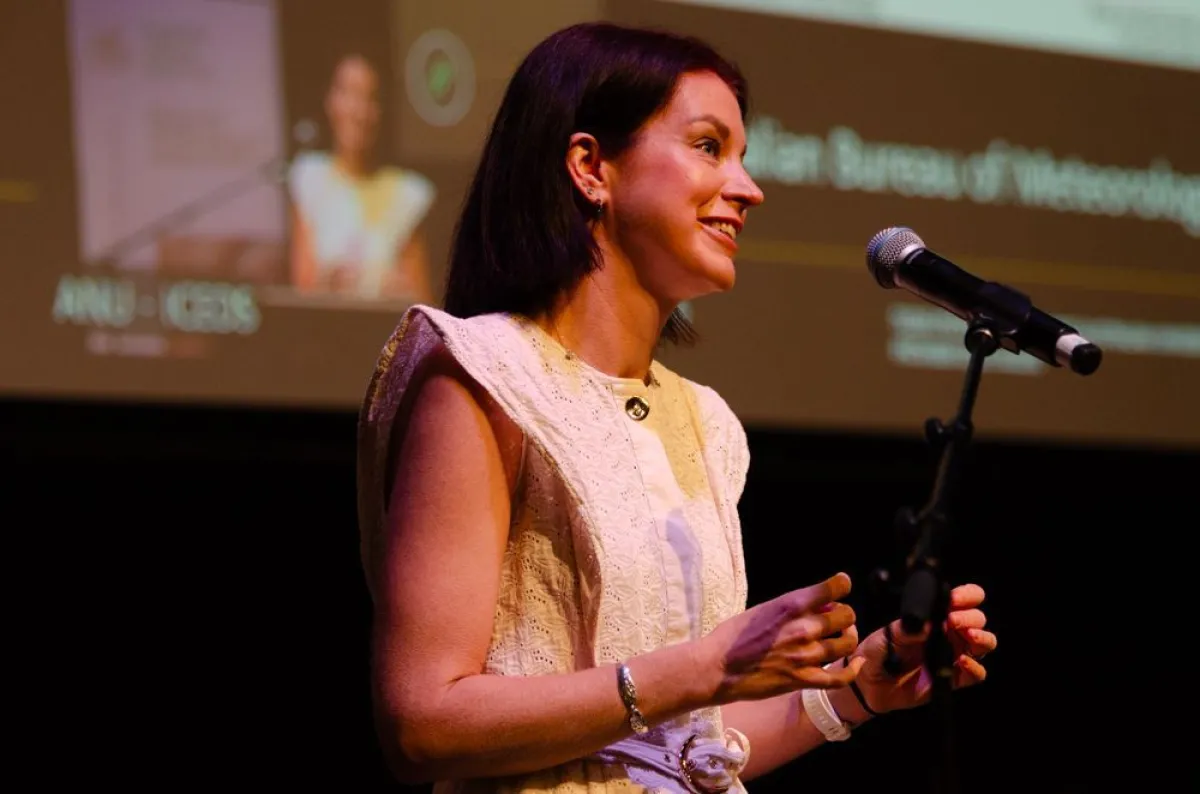
| Professor Sarah Perkins-Kirkpatrick Sarah is a Professor of Climate Science in the Fenner School of Environment and Society at ANU. Over the course of her career, she has focused on extreme heat events and their projections in physical climate models. She is interested in investigating what drives these events, how they may change in the future, and how these changes compare to the historical record. Sarah is also interested in extreme event attribution, which involves isolating the natural and anthropogenic contributors behind certain extreme events. The changing nature of the health impacts of heatwaves are also of interest to Sarah, requiring strong interdisciplinary collaboration with human health experts. Sarah is also passionate about science communication and continues to be an expert voice in various lines of national and international media on all things science, climate change, and heatwaves. She co-hosts the podcast Totally Cooked: The Climate and Weather Podcast. Sarah has won various awards for her work and outreach, including the Australian Academy of Science Dorothy Hill Medal (2021); The Australian Meteorological and Oceanographic Society Communication and Outreach Award (2021) and the Australian Science Communicator of the Year Award (2025). She is the current president of the Australian Meteorological and Oceanographic Society, a coordinating lead author of the Intergovernmental Panel on Climate Change 7th Assessment Report, and the deputy director Engagement and Impact of the ARC Centre of Excellence for the Weather of the 21st Century. |
Image

| Associate Professor Carina Wyborn Carina is an interdisciplinary social scientist working across science and technology studies and human ecology, with a focus on the governance of environmental change. Her research examines collaboration across the science–policy–practice interface, the scientific and governance processes through which land and water agencies respond to environmental change, and the capacities and methods that enable futures thinking in environmental decision-making. She currently works on climate adaptation, water governance, and biodiversity conservation in the Murray–Darling Basin, the Australian Alps, and the western United States. After completing her PhD at ANU in 2013, she worked with government and non-government organisations in the United States, Colombia, and Switzerland, with many of these collaborations feeding directly into management and policy from local to national scales. She co-led the Biodiversity Revisited Initiative, a two-year collaboration of over 300 contributors from 46 countries, and in 2022 received the Society for Conservation Biology's early career award for outstanding contribution to the conservation social sciences. She returned to ANU in 2020 on an ARC DECRA examining foresight practices and anticipatory governance in Murray–Darling Basin water reform, and contributes to the ANU High Country Research Initiative, where her work addresses the governance responses to ecological transformation associated with snowgum dieback. |
Image

| Frank Jotzo is Professor of Climate Change Economics at the ANU's Crawford School of Public Policy, and director of the Centre for Climate and Energy Policy. He leads research on trajectories and policy instruments for decarbonisation, clean energy and industrial transition for Australia and the region, including the potential for green commodity exports like iron. Prof Jotzo led Australia’s Carbon Leakage Review for the federal government and is a member of the NSW Net Zero Commission. He sits on various international advisory boards and bodies including the Science Panel for the Global Energy Transition, and has been in senior author roles with the Intergovernmental Panel on Climate Change. |
Image

| Mentari Widiastuti Mentari is a PhD student at the School of Medicine and Psychology, ANU. She also has eight years of experience in health systems and policy research in Indonesia. Her PhD research explores the complexity of pharmaceutical waste management in Indonesia through a systems science lens, which reflects her commitment to sustainable and effective health systems. Outside of research, Mentari enjoys reading and playing musical instruments. She welcomes new connections on LinkedIn: linkedin.com/in/mentari-widiastuti |
Image

| Peter Swanton Peter Swanton is a Gamilaraay man from Mackay, QLD and an Indigenous Research Associate, Australian National Centre for the Public Awareness of Science. Peter graduated from ANU in 2019 with a Bachelor of Science, majoring in Physics, specialising in Astronomy and Astrophysics. Peter’s work in astronomy initially began with research around black holes and cosmology, but he has since shifted his focus to cultural astronomy and dark sky preservation. Peter’s work will highlight the scientific importance of Indigenous star knowledges, and what we need to do in order to preserve these knowledges on Country, as well as in the night sky. |
Further, Institute Director Professor Llewelyn Hughes and Institute Manager Aidan Muirhead hold ex-officio seats on the Advisory Committee.
ICEDS Strategic Plan
In October 2021 the Institute published its 2025 Strategic Plan. The Strategic Plan committed to build the capacity of the Institute to catalyse and advance
climate, energy and disaster solutions by:
- Facilitating, developing, supporting and catalysing integrated, innovative, transdisciplinary approaches to climate, energy and disaster solutions research
- Developing a program of world-leading executive education and supporting ANU
- Schools to provide undergraduate and postgraduate education across these three themes
- Providing high level policy engagement and advice, media engagement, events and digital communications, positioning the Institute as a leading honest broker of knowledge around climate, energy and disaster solutions
- Supporting capacity building across ANU via development of networks, training, leadership opportunities and career development for ANU climate, energy and disaster risk researchers
- Leading research, teaching and community engagement around ANU Below Zero
The Institute has further published the ICEDS Strategic Plan Extension 2026 which builds on the 2025 plan.