

Short courses
A leading professional short course program, delivered by experts, providing the latest research on climate, energy and sustainability. Designed for professionals, our courses offer practical skills, real-world insights and flexible study options online and in-person.
The ANU Institute for Climate, Energy & Disaster Solutions’ (ICEDS) professional short course program brings climate, energy and disaster decision-makers together with ANU researchers to discuss recent advances in climate science, the energy transition, and disaster-risk science in the context of real-world scenarios. ICEDS short courses explore the social, environmental and economic aspects of climate change, energy change, and disaster preparedness/response, including the challenges and opportunities for policy makers and practitioners across our Asia-Pacific region and the world.
Standard tailored, or private short courses delivered online, in-person or in hybrid mode.
We have an established and successful design for our short courses and regularly offer our standard and tailored courses for individual bookings. We can also offer private short courses to meet your specific organisational needs. This may include specialised topics, industry and policy engagement, or a course that is timed to suit your team’s work program. For more information, contact the ICEDS Executive Education team at icedscourses@anu.edu.au.
This course explores how governments, industry and practitioners can respond to the growing challenge of planning for climate change in urban environments. It brings together global, regional and local perspectives on climate change, cities, resilience, sustainability and urban futures. This course is convened by Emeritus Professor Barbara Norman and brings together leading researchers from across the University to share the latest research and discuss solutions.
Course information | Expression of Interest
Current courses

Gain a practical overview of the latest climate science and policy responses across key sectors. Designed for professionals seeking a clear, up-to-date understanding of climate change and the decisions shaping Australia’s response.

Explore the technologies, economics and policies driving the energy transition. This course gives professionals across government, industry and community sectors a practical overview of current trends, challenges and opportunities in a rapidly changing energy system.

Build confidence in translating current climate science, developments and solutions into meaningful learning. Designed for teachers, school leaders, education designers and policymakers seeking practical knowledge they can apply in classrooms and education settings.
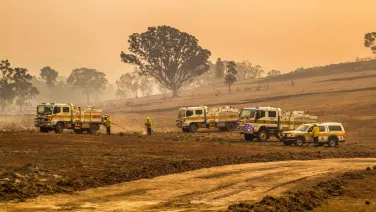
Strengthen your understanding of disaster risk reduction and resilience in Australia and across the Asia-Pacific. Designed for practitioners, policymakers and professionals working with communities, organisations and systems exposed to natural hazards and disruption.

Learn how climate change is reshaping cities, infrastructure and place. This course equips planners and decision-makers with practical insight to support more resilient, sustainable and future-focused urban development.

Develop the judgement and leadership needed to navigate complex climate policy challenges. Explore how evidence, politics, institutions and competing interests shape decisions, and strengthen your capacity to contribute to effective climate responses.

Move from interest to practical application of nature-based solutions. Build the knowledge and confidence to plan, assess and deliver integrated responses for climate adaptation, biodiversity, water management and long-term resilience.

Understand how climate change affects communities, health systems and public policy. Designed for practitioners, policymakers and decision-makers seeking practical insight into health risks, prevention, adaptation and resilient responses.
Schedule
| Course | Start date | End date | Description |
|---|---|---|---|
| Climate Essentials | Thu 19/02/2026 | Thu 19/02/2026 | 1 day, In-person |
| Energy Change Essentials | Fri 20/02/2026 | Fri 20/02/2026 | 1 day, In-person |
| Climate Essentials | Tue 14/04/2026 | Fri 16/04/2026 | 3 x 3.25hr sessions, Online |
| Energy Change Essentials | Tue 21/04/2026 | Thu 23/04/2026 | 3 x 3.25hr sessions, Online |
| Climate Essentials | Wed 19/08/2026 | Wed 19/08/2026 | 1 day, In-person |
| Energy Change Essentials | Thu 20/08/2026 | Thu 20/08/2026 | 1 day, In-person |
| Climate Essentials | Quarter 4 | Quarter 4 | 3 x 3.25hr sessions, Online |
| Energy Change Essentials | Quarter 4 | Quarter 4 | 3 x 3.25hr sessions, Online |
| Climate Essentials for Educators | Quarter 4 | Quarter 4 | 3 x 3.25hr sessions, Online or 1 day, In-person |
| Disaster Solutions | Quarter 4 | Quarter 4 | 3 x 3.25hr sessions, Online or 1 day, In-person |
2026 Course fees
| In-person courses | GST exclusive | GST inclusive |
|---|---|---|
| Full rate | $1890 | $2079 |
| Early bird | $1722 | $1894 |
| Group (3 or more) | $1722 | $1894 |
| Multi-course | $1508 | $1659 |
| Online courses | GST exclusive | GST inclusive |
|---|---|---|
| Full rate | $1785 | $1964 |
| Early bird | $1617 | $1779 |
| Group (3 or more) | $1617 | $1779 |
| Multi-course | $1508 | $1659 |