

Agri-food Systems and Climate Explorer
Research context
Since 2020, ICEDS has been working closely with organisations in the Pacific to examine the challenges climate change pose for food security and food system resilience. As part of this research agenda, ICEDS worked with the Commonwealth Scientific and Industrial Research Organisation (CSIRO) and Samoa’s Ministry of Agriculture and Fisheries (MAF) to develop a tool to support discussions and evidence-based planning around Samoa’s food systems under climate change. The Agrifood Systems Climate Change Explorer (ASCE) was developed in response to a request from the Pacific Heads of Agriculture and Forestry (PHoAF) 2022 meeting. The project was supported by the Department of Foreign Affairs and Trade (DFAT), the Pacific Community (SPC), and the Food and Agriculture Organization (FAO).
Through consultation with Samoan stakeholders, the team identified three main challenges to food system policy making under future climate conditions. These include 1) siloed data, 2) limited general understanding of climate impacts on food systems, and 3) lack of scenario visualisation. Guided by this, ASCE was designed with two main goals in mind. First, ASCE sought to incorporate the data and content most relevant to developing agricultural policies. Second, it needed a user interface and experience to suit the needs and environment of intended users (decision-makers).
Project activities and Outcomes
ASCE integrates climate information and agricultural and socio-economic data into a single tool. It has interactive maps that display different climate variables and future projections based on climate models downscaled to 150-200 km in alignment with Samoa’s districts. Relevant agricultural and socio-economic factors drawn from Samoa’s agriculture census are also included to identify potential risks and opportunities to inform policies. Although ASCE was developed to support the implementation of Samoa’s Food System Pathways (FSP) 2030, it can inform decision-making on a broader range of policies related to drought, crops, livestock, farming practices, government support, technology adoption, water services, and work health and safety.

The project team presented a prototype to the Samoan Government and institutional stakeholders in March 2024. The feedback on both the content and user experience were overwhelmingly positive. The integration of climate and socio-economic variables into a single interface was seen as innovative and useful. The interface was deemed simple-to-use and appropriate for intended users who would not necessarily have an extensive background in climate change. The ASCE approach to present information at a district level was seen as particularly helpful and timely in response to increasing demand from ministers. The prototype was also presented at the PHoAF 2024 meeting and attracted interest from other Pacific islands.
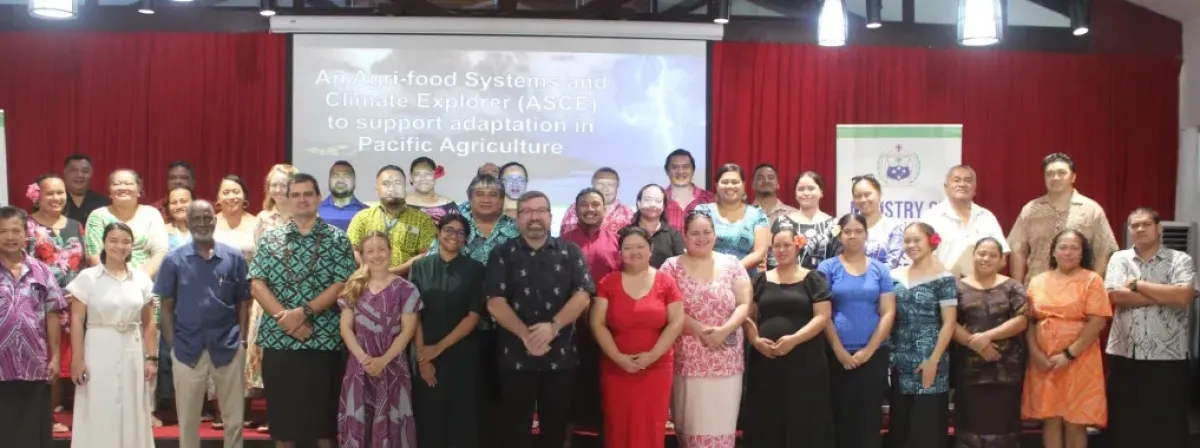
There was an official handover of the ASCE tool to MAF in November 2024. This included capacity building with technical officers so that MAF can continue to update the ASCE as new information becomes available. Through an interdisciplinary and collaborative approach, the project team was able to develop a tool that is useful and appropriate for Samoa. Although it cannot be replicated exactly due to different priorities and contexts, the process and learnings from this project have laid the groundwork for easy adaptation by other Pacific states.
Key details
- Location: Samoa
- Duration: January 2023 – November 2024
- Commissioned organisation: Commonwealth Scientific and Industrial Research Organisation (CSIRO)
- ANU Project Leader: Dr. Steven Crimp
- Partners: CSIRO, Ministry of Agriculture and Fisheries (MAF), The Pacific Community (SPC), Food and Agriculture Organization (FAO), Department of Foreign Affairs and Trade (DFAT)