

Solar photovoltaics
ANU's photovoltaics research is globally leading, focusing on solar technologies from forecasting to high-efficiency cell fabrication. With 65 staff and advanced facilities, the research encompasses silicon and perovskite cells, supported by significant funding, aiming to advance renewable energy integration and innovation.
About
Photovoltaics research at ANU is at the global cutting edge, spanning the entire spectrum of solar electricity technologies—from solar forecasting, to fabricating high-efficiency PV cells, to integrating renewables with storage capacity into the grid.
Our solar laboratories support about 65 staff and students with facilities that enable the fabrication and characterisation of high-efficiency silicon and perovskite solar cells. We also maintain tools for state-of-the-art laser processing, industrial solar cell manufacturing and rapid-throughput characterisation.
Our world-leading silicon solar cell research includes advanced defect characterisation, surface passivation, optoelectronics and the manufacturing of high-efficiency silicon and perovskite solar cells.
We are supported with generous research funding from the Australian Research Council, the Australian Centre for Advanced Photovoltaics, the Australian Renewable Energy Agency and a number of international industrial partners to make the next generation of renewable energy a reality.
Research areas include:
- Silicon Materials
- Silicon Solar Cells & Modules
- Perovskite Solar Cells
- Tandem Cells
- Fundamental, Advanced Concepts & Processes
- Solar Energy Integration
News
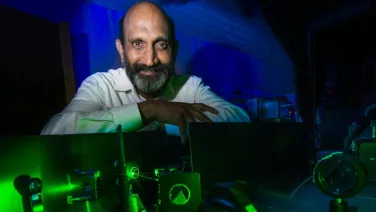
Distinguished Professor Chennupati Jagadish, will be the next president of the Australian Academy of Science.
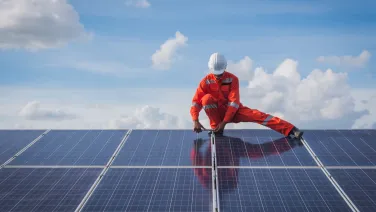
Heather worked as a nurse until a workplace accident caused her to leave the workforce. She put most of her compensation towards making a switch to clean energy, hoping to bring down her energy costs and increase her comfort.

Researchers at The Australian National University working on the photovoltaic potential of ultra-thin 2D materials have made an interesting discovery, the ability of these diaphanous materials to generate solar energy can be controlled by a mere “twist”.